

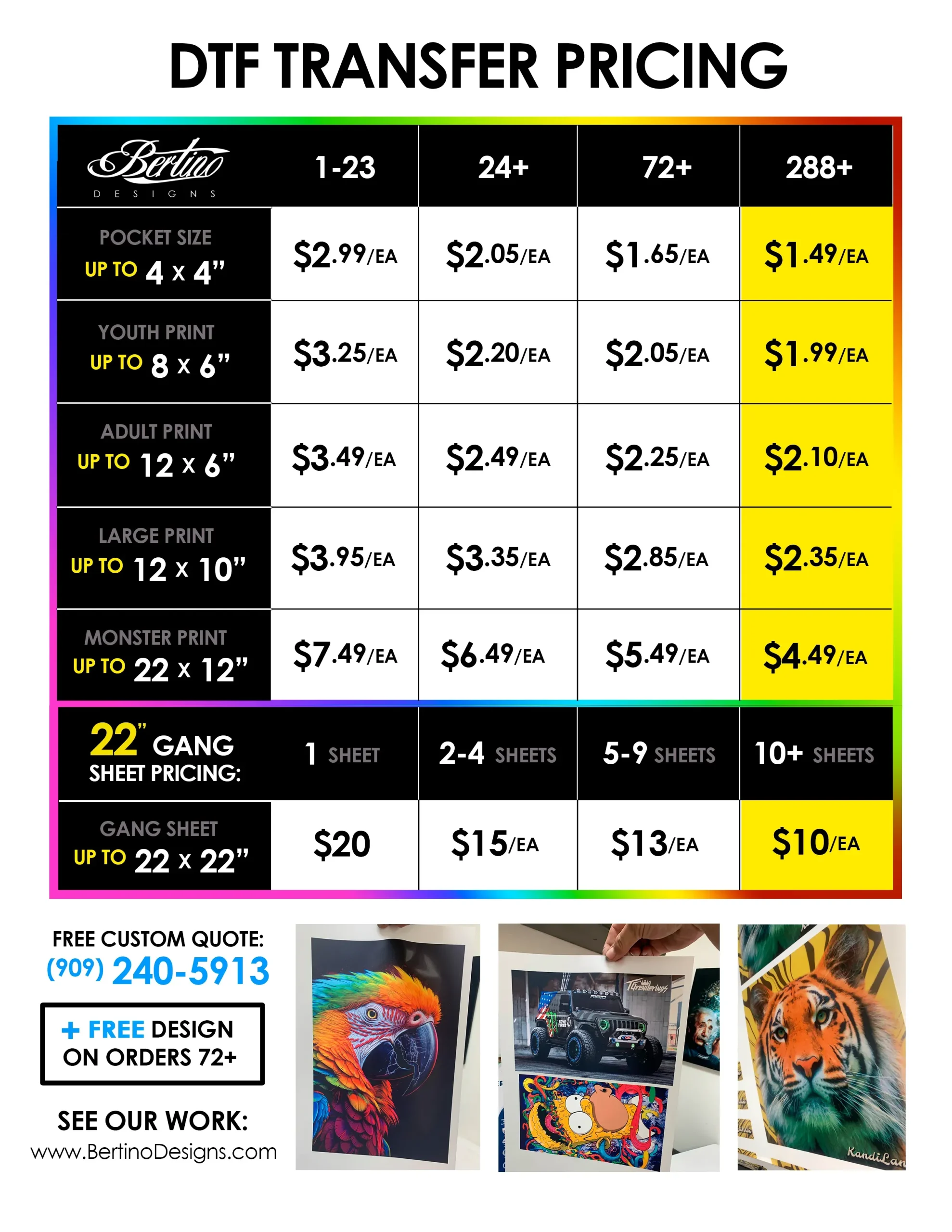
DTF Cost Guide helps small businesses navigate the fast-growing world of direct-to-film printing by turning budgeting into a strategic, data-driven practice that connects everyday purchasing decisions with long-term profitability, supplier relationships, and scalable growth. Understanding DTF printing costs means looking beyond sticker price to examine material quality, printer wear, energy use, labor time, and overhead as a single, per-unit reality that informs every quote you issue. By forecasting per-transfer costs and aligning DTF pricing strategies with actual expenses, you protect margins, plan for seasonal fluctuations, and preserve customer value without compromising print quality across orders. This practical framework helps you forecast costs, allocate overhead to specific product lines, and negotiate with suppliers for sustainable growth while maintaining predictable lead times and reliable service. Whether you are launching a small apparel line or expanding an existing shop, the guide provides a clear, actionable path to profitability, supported by sample calculations, supplier scorecards, and ongoing monitoring.
Think of this topic as a cost framework for direct-to-film workflows, where every expense including materials, machinery, labor, and facility use feeds into unit economics and pricing decisions. Focusing on cost structure and disciplined budgeting helps smaller shops forecast cash flow, justify equipment investments, and optimize the sequence of purchases. Using alternative expressions such as expenditure planning, overhead allocation, and merchandise pricing models keeps the discussion practical without relying on a single technical term. The approach emphasizes data-driven scenario analysis, supplier negotiations, and performance tracking to keep margins healthy as demand shifts. In short, this cost-oriented guide translates raw numbers into clear business wins, providing a practical blueprint for sustainable growth in a competitive market.
DTF Cost Guide for Small Businesses: A Practical Budgeting Framework
Navigating the fast-growing world of DTF printing starts with a solid budgeting framework. A well-constructed DTF Cost Guide helps you map out the main expense categories—materials, equipment, labor, and overhead—and translate them into per-unit costs and monthly budgets. By aligning your spending with realistic demand, you can forecast profitability, set credible pricing, and avoid surprises that stall growth. This approach keeps budgeting actionable rather than theoretical, turning cost awareness into concrete decisions that support sustainable expansion.
In practice, the guide prompts you to consider DTF printing costs across every layer: material inputs like film, inks, and adhesives; equipment costs including the printer and heat press; and ongoing overhead such as utilities and software. It also emphasizes the importance of tracking a metric like DTF cost per transfer to forecast break-even points and margins. With this framework, small shops—from apparel startups to custom print services—can forecast monthly volume, allocate overhead fairly, and price products so margins stay healthy while remaining competitive.
Understanding the Core DTF Cost Components: Materials, Equipment, and Labor
A clear view of DTF costs begins with materials, where the cost of film, pigment inks, adhesive powder, and any pre/post-treatments sets the floor for per-unit pricing. Incorporating the concept of DTF fabric cost helps you account for garment or textile spend, ensuring you don’t overlook the impact of the substrate on overall profitability. Discussing “DTF printing costs” at this level helps you compare supplier quotes, test different films, and optimize ink usage to reduce waste without sacrificing quality.
Beyond materials, equipment costs—depreciation, maintenance, and replacement cycles—are a major driver of long-term profitability. Treat the printer, heat press, and any auxiliary tools as assets with a planned lifecycle, and attach a monthly cost to each to reflect true DTF equipment cost. Labor and time, even in solo operations, deserve attention as a budget item: account for setup, color proofs, and finishing as a measurable per-unit investment, so your DTF cost per transfer captures both material and time inputs.
Calculating DTF Cost per Transfer: From Numbers to Pricing Decisions
Calculating the DTF cost per transfer turns abstract numbers into actionable pricing insight. Start with fixed monthly costs (rent, depreciation, insurance) and allocate them across the expected volume, then add variable costs per transfer (film, ink, powder, packing). This per-transfer view demonstrates how volume changes margins and helps you determine the minimum price needed to break even, guiding smarter pricing decisions under different demand scenarios.
To illustrate, imagine fixed costs of $1,200 per month and variable costs of $1.05 per transfer, with a target price of $6.50. The break-even point would be around 220 units per month, and any sales above that threshold contribute to profit. Tracking DTF cost per transfer alongside actual sales enables timely adjustments—whether it’s negotiating material costs, tweaking print sizes to reduce waste, or altering labor allocations—to protect margins as volumes fluctuate.
DTF Pricing Strategies: Value, Tiers, and Bundling for Competitive Margins
DTF pricing strategies hinge on understanding both cost and customer value. With clear costs per unit, you can pursue value-based pricing that reflects unique designs or branding capabilities, while still maintaining healthy margins. This approach allows you to capture premium segments without eroding overall profitability, especially when your offerings include durable finishes or specialized effects that customers are willing to pay more for.
Layered pricing, tiers, and bundles give you flexibility to grow average order value. For example, offer standard transfers alongside higher-durability or specialty finishes, or create bundles that combine multiple designs at a favorable per-unit rate. Regular price reviews help you respond to supplier changes and demand shifts, ensuring your DTF pricing strategies stay aligned with costs like DTF printing costs and the evolving landscape of materials and equipment.
Budgeting and Supplier Strategy for DTF Growth: Planning, Negotiation, and Monitoring
A robust budgeting approach combines forecasting with proactive supplier management. Map out monthly production targets, then negotiate with suppliers for favorable terms on film, inks, and adhesive powders. Consider bulk purchasing or multi-year pricing when volumes are predictable, and always factor in DTF fabric cost for substrates and apparel when evaluating suppliers. This strategic sourcing helps control material costs and stabilizes your overall budgeting.
To turn budgeting into a living practice, implement a monthly review that compares actuals with forecasts. Track key metrics such as DTF cost per transfer, equipment maintenance expenses, and utility usage, and use these insights to adjust procurement, pricing, and workflows. A disciplined approach—documented in a simple, scalable budget—enables you to plan purchases, negotiate confidently, and monitor expenses over time, supporting sustainable growth in a competitive market.
Frequently Asked Questions
What is included in the DTF Cost Guide for budgeting DTF printing costs?
The DTF Cost Guide covers core cost factors such as material costs (DTF film, inks, adhesive powder, and DTF fabric cost), equipment costs (printer, heat press, maintenance), labor, and overhead. It also shows how to calculate cost per transfer and break-even points to forecast profitability and guide budgeting decisions.
How should I estimate DTF equipment cost within the DTF Cost Guide?
Treat DTF equipment cost as a fixed expense that depreciates over its useful life. Include the purchase price, depreciation (monthly), and ongoing maintenance or replacement reserves. This approach informs monthly budgets and improves cost-per-transfer calculations.
Why is DTF fabric cost included in budgeting under the DTF Cost Guide?
DTF fabric cost, along with other materials like film, inks, and adhesive powder, drives the variable cost per transfer. Tracking per-unit usage, supplier price changes, and waste helps refine per-transfer estimates and protect margins.
What DTF pricing strategies does the guide recommend to maintain margins?
DTF pricing strategies recommended include value-based pricing, tiered options, bundles, and seasonal promotions. Price decisions should reflect the true cost per transfer and target margins while staying competitive with market demand.
How can I compute DTF cost per transfer using the DTF Cost Guide?
Compute cost per transfer by allocating fixed monthly costs (rent, depreciation, insurance) across expected volume and adding variable costs per transfer (film, ink, powder, labor). Cost per transfer = total monthly costs / expected transfers, which helps forecast break-even and profitability.
| Aspect | Key Points |
|---|---|
| Understanding DTF Costs | DTF costs include materials (film, inks, adhesive), equipment (printer, heat press, maintenance), labor, and overhead; translate into per-unit costs and monthly budgets; depreciation is used for equipment budgeting. |
| Cost Drivers & Tracking | Track material costs, equipment costs, labor/time, overhead, and waste/quality control. Assign an hourly rate to your own time and monitor supplier price fluctuations. |
| Budgeting Framework | Define monthly volume, calculate per-unit material costs, account for depreciation/maintenance, allocate labor, assign overhead, compute break-even, and review monthly to refine. |
| Sample Calculations | Illustrative figures show fixed costs, variable costs per unit, target price, and volume to compute break-even and anticipated profit. |
| Strategies to Optimize Costs | Bulk purchasing, optimize print sizes and color usage, streamline workflow, proactive maintenance, material testing, energy efficiency, and outsourcing non-core tasks. |
| Pricing & Market Positioning | Value-based pricing, tiered options, bundles, seasonal promotions, and regular price reviews to protect margins. |
| Common Pitfalls | Hidden costs, underestimated waste, overestimating demand, and lack of ongoing performance tracking. |
| Tools & Templates | Spreadsheets and templates for fixed/variable costs, margins, cost-per-transfer, supplier scorecards, and scenario analyses. |